



The Working Principle of the EDD® Lecher Antenna
The working principle of the EDD® Lecher antenna: from the Vienna line to listening to frequencies
In the history of science there are instruments that cross the decades without ever ceasing to teach us, provided we agree to look at them twice: once to understand where they come from, and a second time to grasp what they have become in the hands of those who never stopped making them evolve. The Lecher antenna belongs to that rare family of tools whose origin is perfectly documented and whose present-day use nevertheless reaches far beyond the setting in which it was conceived. To understand how it works is therefore to follow a double thread: that of physics first, and then that of vibrational experience, which grafted itself onto it without ever betraying it.
The origins: the Vienna line
It all begins in Vienna at the end of the nineteenth century, in the laboratories where a young Austrian physicist named Ernst Lecher was pursuing research on the electromagnetic waves that Heinrich Hertz had only just demonstrated. In 1888 Lecher devised an apparatus for measuring standing waves: two conducting wires stretched parallel to each other and joined at one end by a movable bridge, a shunt, which only has to be slid along the wires to reveal, with remarkable precision for the time, the wavelength and frequency of the signal running through them. He published the details of this experiment in 1890 in a study that earned him lasting recognition, so much so that physicists still speak today of "Lecher lines" to describe this kind of set-up.
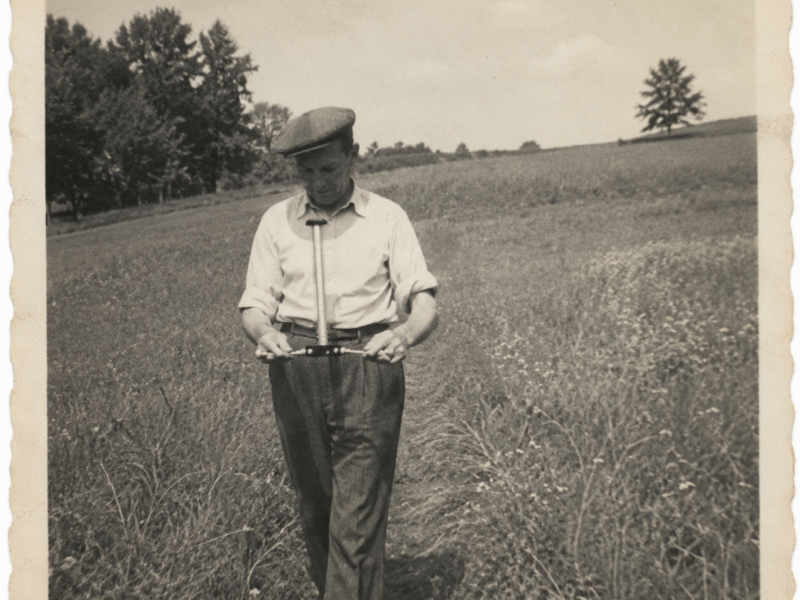
The principle has an almost childlike elegance, and it is precisely this simplicity that made its fortune. Two brass rods set in parallel form what is called a closed circuit: joined at their end by the famous shunt, they allow the current to travel back and forth continuously, creating a stable oscillation whose wavelength can be varied in two ways, either by sliding the shunt along the wires or by changing the length of the rods themselves. It is this same architecture, taken up and adapted, that a few decades later would cross the borders of pure physics and enter the field of exploring the living world, driven by Walter Kunnen, a professor from Ghent, who saw in this set-up far more than a laboratory instrument: a tool capable, in trained hands, of picking up vibrational states that until then had been the preserve of the water diviner's or dowser's intuition.
What the device structurally requires in order to be an antenna
We should pause here on a point that many manufacturers overlook, or choose to ignore because it makes production easier: to deserve its name, a Lecher antenna must meet a basic electromagnetic requirement. Any antenna, whether telescopic, parabolic or Lecher, receives through a structure and transmits through two ends that are connected to each other. Two parallel rods that are not joined at the top do not form a closed circuit, and therefore are not an antenna in the proper sense: in practice they are nothing more than a pair of ordinary dowsing rods, whose operation then rests solely on the sensitivity of the operator, without the support of any real electromagnetic oscillation.
This electrical continuity is not a matter of opinion or belief. It can be checked very concretely with a multimeter: the current must be able to flow without interruption from the operator's emitting hand, through the arm of the antenna, along the wire to the shunt, and then back through the second wire and the second arm. It is a measurable fact, just like any circuit continuity in ordinary electrical work, and it is on this indisputable foundation that the whole legitimacy of a genuine Lecher antenna rests.
The evolution of the EDD®: when design serves use
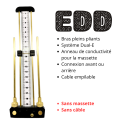
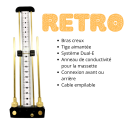
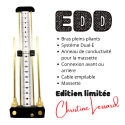
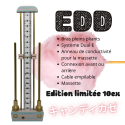
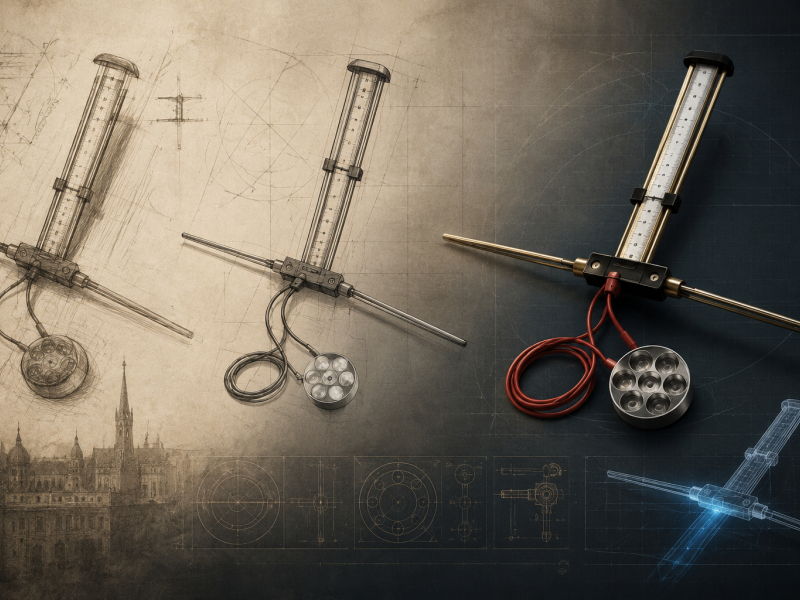
It is precisely at this structural level that the EDD® Lecher antenna has set itself apart over twenty years of continuous refinement. Where Ernst Lecher's original set-up made the shunt a simple movable adjustment point, used to vary the wavelength picked up on wires that were otherwise open at their ends, the EDD® design chose to insulate those ends and force the current to pass through the shunt every time. This modification is purely a matter of construction and can be verified as such: it belongs to the way the antenna is built, not to a hypothesis.
What VED-DISTRI draws from it, on the other hand, belongs to a reading specific to the vibrational use of the tool, and we think it important to present it for what it is: an interpretation built on the repeated experience of practice, not an independent physical measurement. In our approach, the rear return loop for the current, as it existed in the historical set-up, tended to reintroduce a form of parasitic information into the system, diluting the clarity of the signal being sought. By forcing the current to travel only through the shunt, the EDD® antenna produces, in our experience, a single sine wave corresponding to the frequency being sought: a cleaner signal, less prone to the interference the old loop could introduce.
This change in construction has a direct consequence on the very way one works with the antenna. Where traditional dowsing practice very often invites you to verbalise your search, to put the question to the tool in your mind or out loud, the EDD® antenna allows you, within our method, to work differently: you no longer verbalise, you program. The image of the radio illustrates this shift rather well. Looking for a Hartmann line amounts, in this logic, to tuning the antenna to the corresponding frequency, a little as you would turn the dial of a set to pick up "Radio Hartmann" rather than formulating the request in your head; looking for an underground water table likewise means tuning in to what might be called "Radio Water". This move, from mental formulation to direct tuning, is in our view one of the most significant contributions of the EDD® compared with designs that have remained faithful to the original set-up.
Two conditions, and only one limit: the operator
Yet however refined the design of an antenna may be, it never exempts the operator from personal commitment, and this is where the truly vibrational dimension of the practice meets the rigour of its technical side. Two conditions, and only two, make it possible to tell a genuine Lecher antenna, whether EDD® or another design faithful to the original principle, from a mere pendulum, heavy and awkward, that only looks the part.
The first condition is a fact that can be checked objectively: there must be real electrical continuity, from the hand to the arm, from the arm to the wire, from the wire to the shunt, and so on until the loop is closed. Without this continuity, no circulation of subtle energy, the very energy every human being carries within, according to the constant tradition of vibrational practices from the first water diviners to the dowsers of the twentieth century such as Abbé Alexis Mermet, whose work left a deep mark on the discipline in France, can find in the antenna the material support that allows it to show itself.
The second condition concerns the framework of use that we recommend: do not verbalise your search, program it, by tuning the antenna to the frequency that corresponds precisely to what you wish to explore. An operator who kept formulating the question mentally, even on a perfectly built antenna, would remain, according to our method, halfway between the old world of the pendulum and the real potential of the EDD®.
The EDD® antenna thus lends itself to two broad, complementary families of use: working in emission, for remote research or work on a map or plan, when the subject being explored is not physically present; and working in reception, for direct detection and on-site analysis. This dual capacity, together with the two conditions we have just described, outlines a demanding practice, yet one open to anyone willing to train for it seriously.
An instrument, and a whole path as well
For this is where, for VED-DISTRI, the true heart of what we offer lies: the EDD® antenna is never thought of as an isolated object handed to a beginner without support. It belongs to an ecosystem designed so that everyone, from the curious newcomer to the experienced practitioner, can progress at their own pace. Our training centre, LecherSCHOOL, offers a three-hour programme on Saturday mornings, by video conference or in person at our centre in Saint-Hippolyte, Alsace, to lay the essential foundations of electrical continuity and tuning by programming. This initial training continues naturally in our publishing collection: the Interactive Guide to the EDD® Lecher Antenna, the "Vibration" collection, which sets out protocols by field of application, and the Répertoire des Fréquences (Frequency Repertoire), which in 2026 brings together more than three hundred and fifty frequencies classified by theme and available day to day through our mobile and desktop app. Our LecherSCHOOL YouTube channel, with more than fifty videos and five hours of teaching content, and our Facebook community, which in 2026 gathers more than six thousand five hundred members around the world, complete this support, in a spirit of ongoing transmission rather than the mere sale of an object.
Looking ahead
There is, we will not deny it, a certain charm in contemplating the devices of the past, those set-ups faithful even in their limits to Ernst Lecher's original experiment. But just as there is charm in driving a Ford Model T, without anyone seriously thinking of using one for everyday travel, it seems to us that there is greater accuracy, and greater effectiveness, in choosing the tools that our own time allows us to design. The EDD® Lecher antenna has not betrayed the principle that gave birth to it; it has simply carried it to where twenty years of practice, listening and continuous refinement have led us. It is this continuity, between the rigour of a Viennese physicist at the end of the nineteenth century and the demands of a vibrational practice resolutely turned towards today, that we wanted to retrace here.
To discover our full range of EDD® Lecher antennas and choose the model that suits your practice, our team is always on hand to advise you.
Share this content