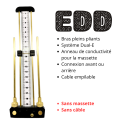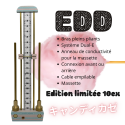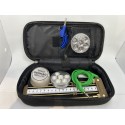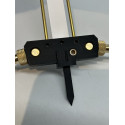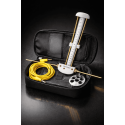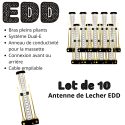






The Court of Miracles of the Lecher Antenna
The court of miracles of the Lecher antenna: what thirty years in the workshop have taught me
Some trades make you wise without your ever seeking it, and mine is one of them. Ever since I first set my files to brass to shape what would, years later, become the EDD® Lecher antenna, I have seen pass across my workbench, and above all in the parcels sometimes sent to me "for comparison" with that mixture of pride and worry peculiar to someone who has just found a bargain, just about everything human ingenuity can produce when it meets the lure of profit without, alas, adding the slightest hint of rigour. Hermes Trismegistus taught, in the founding pages of the Corpus Hermeticum, that what is above is like what is below, and that matter is only ever the coarse reflection of a subtler order. I would add, as a practitioner rather than a philosopher, that a badly made instrument is also the faithful reflection of badly made thinking: you do not knock together a tool of fine perception with the casualness of a craftsman in a hurry to deliver before the weekend.
A scale too small to measure your morning coffee
Let us start at the beginning, or rather with what, in the disorder of today's market, passes for a beginning: antennas from elsewhere, generally from India, which pseudo-manufacturers (the word is too kind; let us call them object dressers) simply re-label before reselling, as if the stamp were enough to confer virtue. Beneath the varnish and the new label one easily recognises the clumsy silhouette of a poorly executed copy of the famous ACMOS antennas, whose historical merit needs no demonstrating and which I would not dream for a moment of disparaging: it is the copies, not the original, that are the problem. For copying is not understanding, and one can reproduce a form for decades without ever grasping the principle that drives it. That, moreover, is the whole tragedy of forgers, in art as in esotericism, and René Guénon, in his Perspectives on Initiation, said nothing different when he distinguished counterfeit from true transmission: the outer form can be imitated endlessly, but the spiritual influence cannot be falsified.
I have held in my hands antennas fitted with a scale so microscopic that I would be hard pressed to measure the diameter of my morning espresso cup with it, and heaven knows I do not drink my coffee from a thimble. What do you hope to measure with such a tool, other than your own disappointment? On a Lecher antenna worthy of the name, the scale is not a cosmetic detail added to look serious: it is the very space where the reading of the wavelength takes place, the precise point where the practitioner's gesture meets the physics of the phenomenon.
When the antenna looks like a Star Wars spaceship
And then there is the opposite excess, just as entertaining to watch if, as I try to, one keeps a minimum of humour in this trade: antennas bristling with so much electrical hardware, so many connectors, buttons and gadgets plugged into one another, that you end up wondering whether you are holding a dowsing instrument or a prop that escaped from the set of a Star Wars episode. I have nothing against futuristic aesthetics (Darth Vader has his fans, and I understand them), but I struggle to see how piling components onto an object whose principle rests on the simplicity of the circuit serves the practitioner's cause. In Foucault's Pendulum, Umberto Eco had fun, with ferocious talent, describing a world where the accumulation of symbols ends up standing in for meaning, where the more esoteric signs one stacks up, the closer one believes one is to the mystery, when often one is only pushing it further away.
In the light of these two excesses, too little and too much, it becomes clear that the Lecher antenna market truly resembles what the French, with their language's elegance in naming disorder, call a cour des miracles, a court of miracles: that quarter of old Paris where fake beggars miraculously became able-bodied again once night had fallen and the onlookers had gone. You find everything there, you meet colourful characters, and anyone venturing in had better keep their eyes wide open.
Keep an open mind, without closing your eyes
I would not want these lines to sound like the bitter indictment of an old manufacturer jealous of his market share. After all, everyone must be able to try their luck and find a place in the sun; the world of craftsmanship has never been a walled garden, and the history of science, like that of the esoteric traditions, is full of modest inventors who became, through perseverance, references in their field. The alchemists of the Renaissance were not all born masters either: how many plodding apprentices, before uncovering the secret of the Great Work, first botched their furnaces and blackened their crucibles in vain? Failure is part of the path, and I will not cast a stone at anyone for simply having tried.
What I urge you never to give up, on the other hand, is your critical sense. For in this field more than any other, a newcomer's enthusiasm is a door wide open to every disappointment, and I have more than once consoled sincere practitioners who had invested in an object that looked appealing in a photograph and proved utterly useless in the hand. The original experiment of Ernst Lecher, the Austrian physicist whose name has crossed the century to settle, almost by historical accident, on our dowsing practices, teaches us three precise requirements. They belong to no particular belief: they are, if I may say so, the conditions that make the instrument possible. Without them, what you hold in your hands is nothing but a rod bent into a U, however nicely finished, and to hope for any result you would then have to utter a vigorous abracadabra and resign yourself to verbalising your search as you would with a pendulum, which is nothing to be ashamed of in itself, but has little to do with the very principle of the Lecher antenna.
What is vital to your Lecher antenna
The first of these requirements, and probably the one most easily forgotten by those who confuse the instrument with a talisman, concerns the source of energy. Your Lecher antenna is not a magic object that acts on its own, like a wand dispensing its effects without the help of the sorcerer: it is a tool that works in resonance with your perception and your subtle energy, the very energy that Eastern traditions call prana or qi, and that Western Hermeticism long referred to as the universal spirit diffused through all matter. Without that contribution, without the part of yourself that you put into the gesture, the most perfectly machined instrument in the world will remain an assembly of cold metal.
The second requirement concerns electrical conductivity, and this is where things most often go wrong with hasty or unscrupulous manufacturers. Energy must be able to flow from your right arm to your left arm without the slightest interruption, and it must pass through the slider: it is this continuity, verifiable with a multimeter for anyone still doubting the physical reality of the phenomenon, that makes all the difference between a genuine instrument of vibrational measurement and a heavy pendulum disguised as a scale. If the current does not flow, if the circuit is broken somewhere between the left wire and the right wire, then your antenna, however elegant it looks on the shelf, is never more than a rod bent into a U.
And finally comes the third condition, that of the slider, a key part too often neglected in its design: it must force one hundred per cent of the electrical energy to flow through it in order to pass from the left Lecher wire to the right Lecher wire. A poorly conducting slider, oxidised or designed without the necessary care, is a half-collapsed bridge over which you would nevertheless ask all the traffic to pass: subtle current, like electric current, does not forgive half-measures.
The current tester, or the virtue of methodical doubt
The good news in all this is that these three conditions are not merely a matter of belief: they can be checked with an instrument as prosaic as a simple current tester, just as you would check the strength of a beam before hanging the whole weight of your house on it. Descartes himself, in his Discourse on the Method, urged us to accept nothing as true that we had not carefully examined; he was certainly not talking about Lecher antennas, but the spirit that drove him applies wonderfully here. Still, you need to understand what you are measuring, for matter has its traps and its false certainties.
If the Lecher wires simply form a rod bent into a U in a single piece, electrical conductivity will in fact exist, through the metallic nature of the part alone, from the right arm to the left arm, and one might wrongly believe the instrument to be perfectly functional because the current flows through it. This is precisely where the slider must come into play: if this part, which is supposed to modulate and channel the passage of energy, is not itself fully conductive, it serves literally no purpose, other than looking pretty on the wire.
The family of Abracadabra antennas
So when you come across Lecher antennas whose slider is made entirely of plastic, or whose slider is not in real contact with the Lecher wires, or whose arms do not even touch the wires they are supposed to extend, ask yourself very seriously: how can this possibly work? I readily admit that I do not have all the answers, far from it, and I claim no omniscience about the merits of every object circulating on this market. But for want of a better term, I have got into the habit of calling this very particular family the Abracadabra antennas, because to my mind they bring us much closer to the classic pendulum than to the Lecher antenna as Ernst Lecher himself understood it.
 |
 |
| Plastic slider: no electrical connection. | Slider with a 100% conductive link. |
If I had to give just one piece of advice, it would come down to three verbs: think, observe, and above all ask yourself how it really works. Your antenna is not magic, it is technical, in the same way that a radio set is tuned to a frequency with a dial before you switch on the power to listen to what you have tuned in. Do not be credulous, ask questions before you buy, and above all do not let yourself be wrapped in a cloud of mystery manufactured from scratch to hide a lack of technique.
Steer clear of those who can only speak ill of others
I will add one last observation, subtler perhaps but just as valuable for anyone navigating this court of miracles: be wary of, and even flee from, anyone whose sales pitch is built solely on running down other people's antennas, whether in speech or in writing. Claiming that your neighbour's product is worthless has never shown, by any twist of logic, that your own is any good. These are two separate statements, and the second never follows automatically from the first. And as you know, you who move in this world of energy and subtlety, directing negative energies and words at others is in itself a red flag that should send you running. Nothing solid is ever built on the ruins one inflicts on others, and the spiritual history of humanity, in every latitude, has said so tirelessly. The Gospel of Matthew puts it with an economy of words that has lost none of its force over the centuries: "Judge not, that ye be not judged."
Tolerance and kindness on the path of harmonisation
For in the end, that is what it is all about when one ventures onto the path of dowsing, harmonisation and spiritual research: a path, precisely, and not a competition in which rivals must be eliminated to earn the right to reach the end. The oldest traditions agree, beyond their differences in vocabulary and ritual, on one point that each generation rediscovers with the same astonishment: inner peace is never won against others; it is cultivated with them, or at least alongside them. Mircea Eliade showed how the rites of passage of traditional societies aimed less at separating the initiate from the rest of the world than at reintegrating him, transformed, into a wider community. True esotericism does not isolate, it connects: according to an etymology often put forward, the very word religion goes back to the idea of binding together, religare.
So in tolerance towards paths different from our own, and in kindness towards those who are starting out or who make mistakes, there is something more than mere social politeness: there is a deep coherence with the very object of our research. How can one claim to harmonise a place, a person or a frequency while cultivating discord and contempt in one's own words? The tool you hold in your hands, however well designed, will only ever be worth as much as the intention that guides it. That is why, rather than the logic of disparagement, I prefer that of patient transmission and demanding dialogue: informing you, equipping you with solid technical reference points, and then leaving you free to choose, in all conscience, the instrument that suits you.
On our website you will find ved-distri.com, our whole collection: the EDD® Lecher antenna, the Rétro, the Asclépios and the German model, designed to cover the full range of needs and practices, from the curious beginner to the seasoned researcher. But whichever instrument you lean towards, remember that true harmonisation always begins a little before the slider touches the wire: it begins in the quality of the gaze we turn on ourselves, and in the kindness we choose, every day, to offer to other seekers of truth.
Share this content