Search on blog
Latest blog posts





Ernst Lecher Antenna
There are moments when matter seems to remember. When brass, patiently worked by the craftsman's hand, becomes once again the silent witness of an intuition born a century and a half ago, in the laboratories where Ernst Lecher, in 1888, gave birth to his line – the Lechersche Drähte – without yet knowing that, through the vision of Reinhard Schneider, it would become the foundation of a subtle art of vibrational measurement.
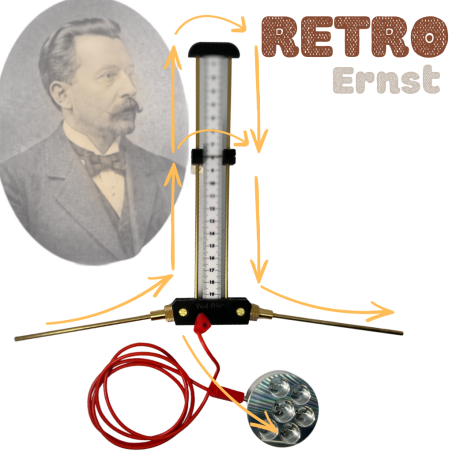
The Ernst antenna does not merely bear this name as a tribute. It revives its founding principle. Where our EDD and Retro models let the energy loop flow from the emitting arm towards the base, rise along the Lecher wire, cross the shunt, descend through the opposite wire and close in the receiving arm, the Ernst model introduces a singularity: the loop also finds its way through the cap itself. It thus closes the exact circle traced by the original experiment of 1888, recovering in a contemporary gesture the purity of the founding one.
That of the Austrian physicist who, seeking to measure the invisible, opened a path that no one suspected would one day guide the dowser's hand. And that of today's craftsman, who closes this loop after one hundred and thirty-eight years of silence, research and transmission. The brass, chosen for its electrical continuity and exceptional conductivity, is not a mere material here: it becomes the conductor of a lineage, the thread stretched between a nineteenth-century discovery and a living twenty-first-century practice.
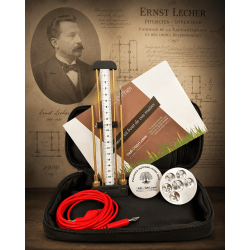
Each Ernst antenna is assembled by hand, one by one, by our expert, with absolute respect for the proportions and balances that have always made our instruments' reputation. It is not produced: it is composed, as one composes a rare piece intended to mark a milestone. As much an instrument of measurement as of homage, it is intended for those who wish to hold in their hands not only a precision tool, but a piece steeped in history – the meeting point between the origin and the future of Lecher's discovery, revisited by Schneider and carried forward today by the work of Éric Daub.