


Your Lecher Antenna Is a Pendulum If You Don't Have Dual-E Mode
A Lecher antenna is not magic, it is technical: it is a circuit, and everything depends on what flows through it. When the operator's energy stops in the arms, the instrument merely follows the operator's feeling, like a pendulum. The Dual-E mode of the EDD® Lecher Antenna returns to Ernst Lecher's original experiment.
The Lecher antenna is not magic, it is technical
The Lecher antenna is surrounded by an aura of mystery that does it more harm than good, as if the instrument drew its answers from some special grace granted to the person holding it. The reality is plainer, and to our eyes far more beautiful: a Lecher antenna is first of all a circuit, a path offered to energy, and the quality of that path determines the quality of the measurement. When the operator's energy truly passes through the instrument, the antenna does the work; when it stops along the way, the operator works alone, and the antenna simply follows the movement of the hand.
This is the whole point of the Dual-E mode of the EDD® Lecher Antenna, which we would like to present here without emphasis, going back first to the source, that is, to the experiment of the physicist who gave the instrument its name. Readers discovering the antenna will find the essential landmarks here; those who already own an EDD® will understand why it is held the way it is; and experienced practitioners may recognise an intuition they had felt without always putting it into words.
Back to the source: the Lecher wire experiment
Around 1888, in Vienna, the Austrian physicist Ernst Lecher (1856-1926) extended the work of Heinrich Hertz, who had just demonstrated electromagnetic waves, and that of Oliver Lodge. His apparatus was remarkably simple: two parallel wires, several metres long, into which a spark-gap oscillator injected a high-frequency wave. The wave travelled along the line, was reflected at its end and formed standing waves along the wires, with points where the voltage drops to zero, the nodes, half a wavelength apart. By sliding a small gas tube along the wires, which glows under voltage and goes dark at the nodes, or a movable conducting bridge, Lecher located these nodes and thus measured, for the first time with such precision, the wavelength of a high-frequency signal. He published the study in 1890 under the title Eine Studie über elektrische Resonanzerscheinungen, and the Lecher line remained a frequency-measuring instrument until after the Second World War.
What matters in this experiment is that everything rests on circulation. The wave enters on one side, travels along the wires without interruption, meets the bridge and finds its tuning there: remove the continuity of the circuit, and there is no standing wave, no node, no measurement. The movable bridge is not an ornament; it is the point where the length travelled answers to the frequency sought.
In the twentieth century, between the 1960s and the 1980s, the engineer Reinhard Schneider transposed this principle into the field of radiesthesia, building on Lecher's research. The instrument became portable and two-handed, and the slider moving along a graduated scale took over the role of the movable bridge. The lineage is direct: the slider on our antennas is the heir to Lecher's bridge, and it only makes sense if something flows through the wires it connects.
When energy does not flow: a pendulum in disguise
Now take an antenna whose arms are not electrically connected to the Lecher wires. The operator picks it up; their energy enters through the hands, reaches the arms, then stops at the entrance to the base, with nowhere to go. It stays there, in the arms, and never rises into the wires. The slider may glide from one end of the scale to the other, but it no longer connects anything: it takes the place of Lecher's bridge without fulfilling its function.
And yet the antenna moves, which is where the confusion begins. It moves because the operator feels, and that feeling is translated, through very fine movements of the hand, into the swing of the instrument, exactly as the string of a pendulum translates the feeling of the person holding it. We have nothing against the pendulum, a respectable tool in the hands of a trained practitioner, but things must be called by their name: a Lecher antenna in which energy does not flow is, in the way it works, a two-handed pendulum.
A pendulum, however, does not know by itself what it is being asked. That is why, with such an instrument, the operator has to verbalise the search, to put the question into words, silently or aloud, in order to steer their own feeling. The answer then depends on the accuracy of the wording, on the inner state of the moment, on the conscious or unconscious expectation that colours the question. The slider no longer plays any part in selecting what is being sought.
The Dual-E mode: energy flows, the slider selects
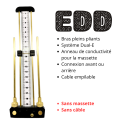
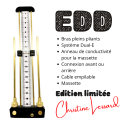
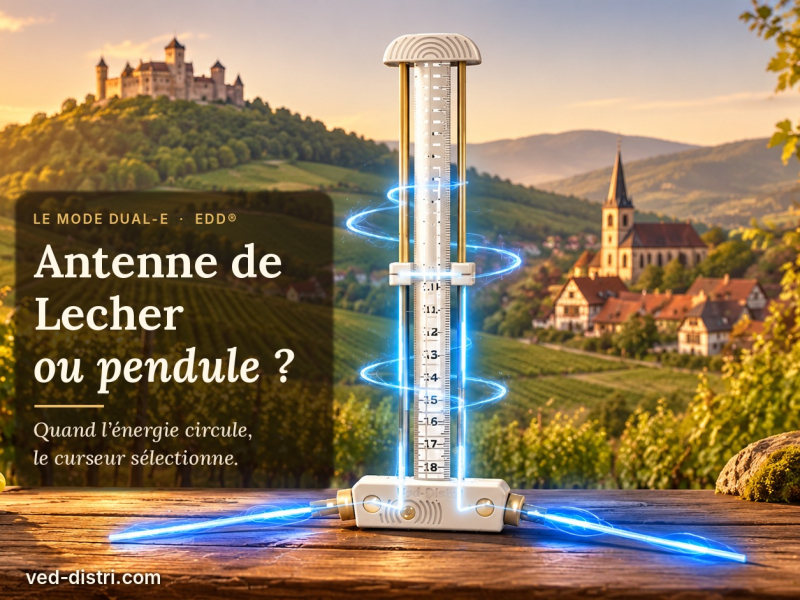
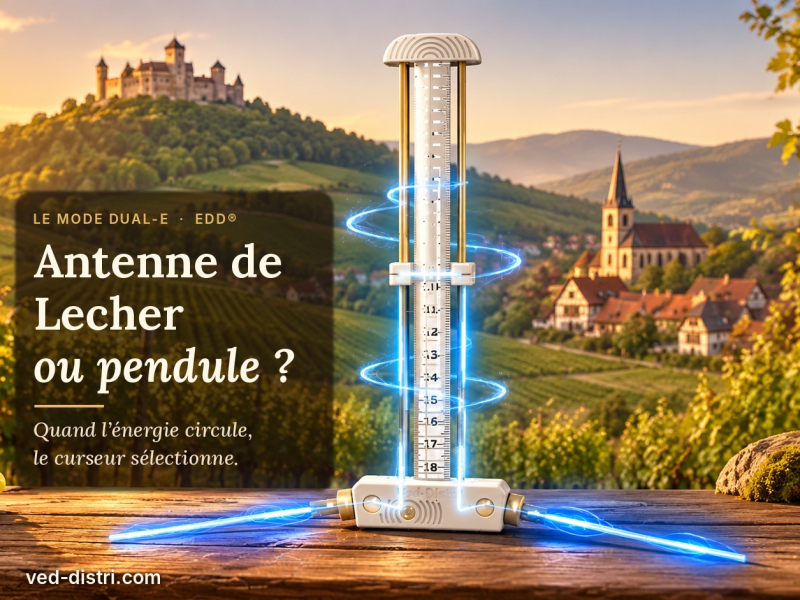
The Dual-E mode of the EDD® Lecher Antenna returns to the logic of the original experiment. The hands always touch the arms, and the arms touch the Lecher wires, so that the operator's energy finds a continuous path: it enters through the right arm, crosses the base, rises through the first wire, passes through the slider, comes down the second wire, crosses the base again and reaches the left arm. This continuity is not a matter of belief; it can be checked with a simple multimeter, from hand to hand, through the whole instrument.
Once energy flows, the slider recovers the function of Lecher's bridge. You set it to the frequency you are looking for, and the antenna responds to that frequency, like a radio whose dial you turn to the station you want: nobody has ever needed to say the station's name aloud to hear it; you only need to be on the right frequency. The same is true of the EDD® in Dual-E mode, and verbalising the search becomes unnecessary, since it is the slider setting, not the wording of a question, that tells the antenna what you are listening to. This is why our books, starting with the Frequency Directory, give slider positions rather than phrases to recite.
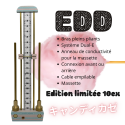
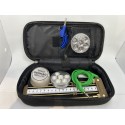
Experienced practitioners know the one exception to the rule, which confirms it rather than contradicts it. When a capture bar is connected to the EDD®, the arm on the connection side is unlocked so that it no longer touches the wire, and continuity is restored another way: capture bar, cable, first Lecher wire, slider, second wire, opposite arm. The path changes its point of entry; it is never broken.
Nothing magic, then, in any of this. The Lecher antenna becomes once more what it was in the Viennese laboratory of 1888, an instrument that tunes a length travelled to a frequency, and the operator can at last devote themselves to what is truly theirs: the clarity of their inner state, the correctness of their grip, the attention they give to the answer.
Letting energy through
Between the antenna that lets energy flow and the one that holds it back in the arms, the difference lies neither in the shape nor in the prestige of the object, but in a conducting thread, in the most literal sense of the term. One carries on Ernst Lecher's experiment; the other quotes it without reproducing it. It is this faithfulness to the principle that we have cultivated since 2009 in our workshop in Saint-Hippolyte, and that we pass on in the LecherSCHOOL training courses (taught in French), where the Dual-E grip is learned with your hands on the antenna.
To discover the instrument itself, the EDD® Lecher Antenna is waiting for you in our shop.
VED-DISTRI, the specialist in the multidisciplinary EDD Lecher antenna.
Share this content