

The Lecher Antenna Wars: It All Comes Down to the Rear Loop
The Loop and the Sine Wave — Why VED-DISTRI® Chose to Free Its Antennas From the Rear Loop
There comes a moment, in the history of every instrument, when heritage stops being a given and becomes a choice. The Lecher antenna, as practiced today in geobiology, radiesthesia, and energy work, stands precisely at that crossroads. It is this choice — removing the rear loop that, since the earliest antennas built at the end of the last century, closed the circuit between the two arms — that we would like to discuss here, with all the rigor and all the care the subject deserves.
What the Loop Was, and What It Did
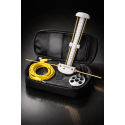
To understand what VED-DISTRI chose to remove, one must first understand what the rear loop technically contributed to antennas built according to the design inherited from Ernst Lecher's work. In 1888, in Vienna, this physicist demonstrated the phenomenon of standing waves traveling along two parallel conductive wires — a discovery in pure physics, still taught today, that originally had nothing to do with geobiology or radiesthesia. It was only decades later that practitioners repurposed this principle into an instrument of perception: two brass arms, joined at one point by a movable bridge — the cursor — and closed, at the rear, by a loop that restored circuit continuity between the two rods.
That loop had its own logic. In designs inherited from the end of the last century, it ensured a return of current which, from a purely electrical standpoint, completed the closed circuit needed for the antenna's mechanical operation: the captured electromagnetic energy had to travel a closed path in order to convert into movement perceptible to the practitioner. Because the loop is closed, the captured electromagnetic energy converts into mechanical effect: the antenna, held in balance by the operator, tips or pivots the moment even the faintest impulse breaks that balance. The loop fulfilled that function — which is precisely why so many antennas built over the past half-century still include it, and continue, in their own right, to work on that principle.
Credit is due here to that original design: it is neither a mistake nor a makeshift solution. Generations of practitioners have used it, and still use it, with results they themselves consider satisfactory. It is not the validity of that approach we are questioning, but its degree of optimization measured against a use case that we at VED-DISTRI have sought, without relent, to refine since 2009 — generation after generation of instruments, each one correcting what the last had left room to improve.
But a closed circuit of this kind has a characteristic that daily practice, honed over years of intensive use, never fails to reveal: what comes back through the loop is never perfectly identical to what went out. The return current, traveling back along a path distinct from the one it was emitted on, superimposes itself onto the frequency the practitioner has just programmed. It does not cancel that frequency, nor does it contradict it — it simply adds to it, the way an echo layers itself over a voice.
Why We Chose to Remove It
It is precisely this superimposition that EDD® technology, developed by Éric Daub and refined generation after generation since 2009, set out to eliminate. The technical choice VED-DISTRI made was to isolate the wire endpoints and force the entire current to pass through the short-circuit bridge, never returning by way of a looping path. The result, as our own practice — and that of the thousands of practitioners who use our instruments daily — confirms year after year, is a cleaner sine wave for the programmed frequency: a single signal, unclouded by a parasitic return, which the antenna delivers with a clarity the loop, by its very nature, could not provide.
It is worth being precise here about the nature of this claim: this is an interpretive framework specific to the vibratory use we make of the instrument, built on our workshop's accumulated experience and on the constant feedback of our community of practitioners — not an independent physical measurement in the strict sense of a metrology laboratory. This is a distinction we're careful to state clearly, out of honesty toward you: we are speaking here of the coherence of a perception tool refined for a precise use, not of a theorem in telecommunications physics.
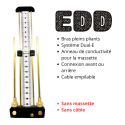
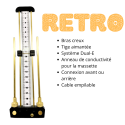
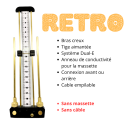
This choice ultimately answers a very simple question that every demanding practitioner eventually asks: why cultivate such quality of listening — the antenna's capacity to reveal the faintest variations in an energy field — only to then let that listening carry a parasitic signal introduced by the circuit itself? A fine ear gains nothing from being placed next to a crackling loudspeaker. It is this logic, and this logic alone, that guided the removal of the loop across our entire current range — the EDD® antenna, the RETRO® antenna, and the ASCLEPIOS® antenna — through four successive generations.
This pursuit of signal purity did not stop at the question of the loop alone. Each generation brought its own share of meticulous, cumulative refinements: unifying the brass across the entire device, a metal chosen for its conductivity and its stability over time; installing a brass contact ring at the base of the antenna, to perfect electrical continuity at the exact point where it matters most; knurling the locking nuts on the rods, so that the adjustment gesture itself would introduce no mechanical play capable of skewing the reading. Nothing in the current design of our antennas has been left to chance or to habit: every element has been rethought in light of this same demand for continuity and signal clarity.
What This Changes, Concretely, in Practice
For the practitioner discovering this approach, the difference isn't always expressed in technical terms — it is felt, more simply, in the crispness of the response. An antenna whose signal isn't overlaid by a parasitic return tends to produce a clearer, less hesitant swing at the exact frequency it has been set to. The practitioner spends less time repeating a reading out of doubt over its reliability, and more time interpreting what that reading actually reveals about the place, object, or person being explored.
This clarity comes fully into its own in the most demanding uses of our instruments: detecting underground water, locating a telluric network or a geological fault, assessing the vibratory rate of a place or a living being, or building, protocol after protocol, a fine-grained energy diagnosis. In each of these uses, the slightest ambiguity in the signal has a direct bearing on the confidence a practitioner can place in their own reading — and it is precisely that confidence we have sought to strengthen, instrument after instrument.
The Two Conditions Every Lecher Antenna Must Meet
Removing the loop in no way exempts an instrument from the two conditions without which, in our view, no device truly deserves the name "Lecher antenna" — whether or not it retains that loop.
The first is purely electrical, and verifiable by anyone with a multimeter: there must be real continuity between the arm, the wire, and the short-circuit bridge. Without this measurable continuity, what one holds is no longer an instrument grounded in the principle of Lecher lines, but a simple weighted pendulum whose shape evokes an antenna without sharing its function. This is a technical, objective distinction that rests on no belief whatsoever: it can be verified with a multimeter in a few seconds, and we encourage every practitioner, beginner or seasoned, to run that check on their own instrument.
The second condition concerns the practitioner's method more than the antenna's construction: the complete absence of verbalization during the search. One does not mentally phrase a question; one programs a frequency, with the same economy of gesture it takes to tune a radio to a given station. Searching for a telluric network isn't a matter of asking oneself where it lies — it means setting the antenna to the frequency that corresponds to it, then observing, in silence, what the arm reveals. This discipline protects the search from the most common and hardest-to-detect interference of all: that of the practitioner's own mind, which, in its eagerness for an answer, sometimes ends up suggesting one.
DUAL-E Mode: Freedom Left to the Practitioner
This is where the most distinctive contribution of our instruments comes in: DUAL-E technology, of which VED-DISTRI remains, to this day, the sole holder among Lecher antenna manufacturers. This switchable mode guarantees perfect continuity of energy circulation between the two arms, and can be activated or deactivated depending on the nature of the work at hand — emission-mode research, at a distance or from a plan, or reception-mode research, close to the body or the site being explored.
We want to be clear on this point, since it's a nuance we're often asked to clarify: removing the rear loop does nothing to close the door on verbalization for practitioners who, trained in other schools or simply attached to that method, wish to keep working that way. DUAL-E offers this flexibility — working by frequency alone, within the discipline of silence we teach at LecherSCHOOL, or returning, if the practitioner prefers, to a verbalized practice. It is not our place to settle that question on behalf of the person holding the instrument; our role is to build a tool precise enough to serve either method without ever introducing, itself, any distortion of the signal.
An Acknowledged Exception: The Ernst Model
It would be dishonest of us to present the removal of the loop as an absolute principle, applying to every one of our instruments without exception — because that isn't quite the case, and we would rather tell you so with the same candor we've brought to the rest of this piece.
Our anniversary model, the Ernst Lecher antenna, makes precisely the opposite choice: it deliberately restores, by design, the original return loop, by way of a cap ("chapeau") built for that purpose. This is not a contradiction in our approach, but a conscious tribute: this model was conceived to let those who wish to reconnect, for the duration of a practice session, with the exact geometry of the very first instruments, while still benefiting from the manufacturing refinements our workshop has accumulated since 2009. The Ernst does not claim to be superior to our loop-free models, nor the reverse: it answers a different desire — that of historical experience rather than that of a purified sine wave. Both approaches coexist within our range, each fully owned, because the richness of a practice also lies in the diversity of paths that lead to it.
Living Alongside the Debate
We know this choice — removing the loop across most of our range — is far from unanimous. On certain forums, in certain groups, voices regularly rise to insist that the loop is indispensable, that the antenna simply won't work without it, or, more bluntly, to cast doubt — sometimes with a vigor that goes well beyond technical debate — on the reliability of our instruments.
We never answer criticism with criticism of our own. This isn't a marketing posture; it's a longstanding conviction, rooted in how we see our craft: we do not discredit other manufacturers, researchers, or schools that make a different choice than ours, whatever tone they may take toward us. We believe deeply in freedom of expression, including when it is directed against us, and we would rather invest our energy in dialogue with those who use our instruments than in polemics with those who criticize them from the outside. You write to us, you call us, you share your observations and your doubts — and it is that daily, patient exchange, built since 2009, that truly feeds the evolution of our antennas, far more than any controversy playing out online.
There is, moreover, a coherence between this choice never to name or characterize a competing manufacturer and our technical approach itself: we would rather build, year after year, the positive proof of what our instruments make possible, than define ourselves in opposition to what others offer. A looped antenna works, for those who choose it — we make no claim otherwise. We simply state, with the same honesty, that our own experience as both maker and user has led us to a different choice, and that this choice finds its strongest validation not in theoretical debate, but in the real, daily use made of it by the practitioners who place their trust in us.
We are well aware, of course, that a debate this old will not be settled by a single article, however well documented. It will continue, as it has continued for as long as radiesthesia and geobiology have existed as structured practices, and we have neither the intention nor the pretension of putting a final word to it. What we can offer, instead, is the transparency of our own path: stating plainly what we chose, why we chose it, and how far that choice goes — without concealing its limits, as we did above regarding our Ernst model. A discerning reader, whether or not they share our conclusions, deserves at least that much clarity.
Proof Through Practice
Because this, in the end, is the argument that matters most to us: thousands of professionals — geobiologists, radiesthesists, energy therapists — use our antennas every day to support their clients, in contexts where approximation has no place. This validation through constant, repeated practice, under real working conditions, seems to us far more eloquent than any theoretical argument exchanged on a forum.
That trust was not built in a day, nor by the strength of a marketing argument alone. It was built exchange by exchange, call by call, with practitioners who shared their observations, their difficulties, and sometimes their doubts with us — and who, through that ongoing dialogue, contributed as much as we did to refining our instruments. It is also to extend and structure this transmission that we published the Interactive Guide to the EDD Lecher Antenna, then the Répertoire des Fréquences (Frequency Directory), co-written with our daughter Marie, which today brings together more than three hundred and fifty frequencies organized into major families — human, subtle, astral, natural, lithic, chromatic, and domestic. These are not mere spin-off products: they are the written memory of a practice that, since 2009, has never stopped growing richer from the observations of those who use our antennas.
This practice, we have chosen to document and share as widely as possible, through an ecosystem we have been building since VED-DISTRI's earliest days:
- LecherSCHOOL, our training center, offers remote sessions every Saturday morning on Zoom, as well as in-person training at our workshop in Saint-Hippolyte, Alsace: lecherschool.com — Zoom training sessions — in-person training in Saint-Hippolyte
- Our YouTube channel, with more than fifty videos and several hours of free educational content, walks step by step through the antenna's uses and the protocols that structure our practice: youtube.com/@ericdaubved-distri5562
- Our Facebook community, several thousand members strong, exchanges daily around these practices: facebook.com/Eddlecherschool
- Our dedicated app puts the full range of our resources within reach on a smartphone: ved-distri-frequences.glide.page
- Our instruments themselves: the EDD® antenna, the RETRO® antenna, the ASCLEPIOS® antenna, and, for those seeking the heritage experience of the restored loop, the Ernst antenna — along with our antenna configurator, the first of its kind, which lets anyone personalize their instrument to their needs.
Conclusion
Removing the rear loop is, at VED-DISTRI, neither a dogma nor a sales argument built against anyone: it is the fruit of a technical journey pursued since 2009, refined generation after generation, in constant dialogue with the practitioners who bring our instruments to life. We know other choices exist, that they work for those who make them, and we respect them without reservation. We simply invite you, if the subject interests you, not to settle the question on the strength of an online debate alone, but to come and test it for yourself — in your hand, in your practice — through one of our instruments or one of our free training sessions.
That, in the end, is the only ground on which we have ever wished to convince anyone: the ground of direct, silent experience, and of the frequency truly and precisely found.
Share this content